Thursday, 5 June 2014

Colonial Williamsburg


Today I spent the day in 'Colonial Williamsburg' - a preserved and reconstructed late 18th Century town which is entirely run as a 'living history' site with authentic buildings, costumes , trades and businesses, houses, re-enactments and characters depicting the final days when the town had a British 'royal' Governor who lived in the Givernor's Palace.

At the start of the day the skies were very threatening but after a downpour it stayed sunny for the rest of the day.


Wednesday, 4 June 2014

James River


This afternoon we drove south in Virginia to the colonial city of Williamsburg.


Our hotel is outside the city on a golf resort on the James River.  Jamestown, on the other side of the river is where the original settlers from Bristol landed.

It was very warm this evening, around 30C and very humid.  We had dinner on a terrace overlooking the river.  Walking back to our room we saw many fireflies, but they were too small and their light too transient to capture in a picture.

Tuesday, 3 June 2014

Tiny Visitor


Ever since we started feeding the birds I have been eyeing up the hummingbird feeders in the shops and wondering whether they would really attract any of these tiny creatures.

In the winter cold it was hard to imagine that such a tropical bird would ever be interested in being here but now that it is as balmy as a summers day in the tropical house at Bristol Zoo, it is a different story and apparently the migration from Central and South America brings these birds - usually on this Eastern side of the country the Ruby Throated Hummingbird - from mid April onwards and they are here until early October.


We bought our feeder a few weeks ago but with some scepticism and only actually filled it with the 'nectar mix' - essentially coloured sugar water - at the weekend.  The guidance advised that it would be several weeks before it would be noticed.  It is not as golden as it appears here, more like Rose Hip Syrup used to look, evidently red is an important colour to attract them, hence the little red flowers that surround the feeding holes.

This evening, to my complete surprise, I looked up to see a tiny fairy-like creature hovering at the feeder...

No photo yet, I didn't dare move, but we are very thrilled to have attracted our first little 'hummer' and hope to capture a photo soon!

(Shortly afterwards our friend the grey cat  turned up on the decking so we didn't anticipate that our tiny visitor would return today..)


Monday, 2 June 2014

Occuquan


After visiting Gunston Hall yesterday we drive on to Occuquan, a small historic village, settled by Europeans in the 18th Century but named by Native Americans. It is on the banks of the river of the same name, a tributary of the Potomac and is in Prince William County.


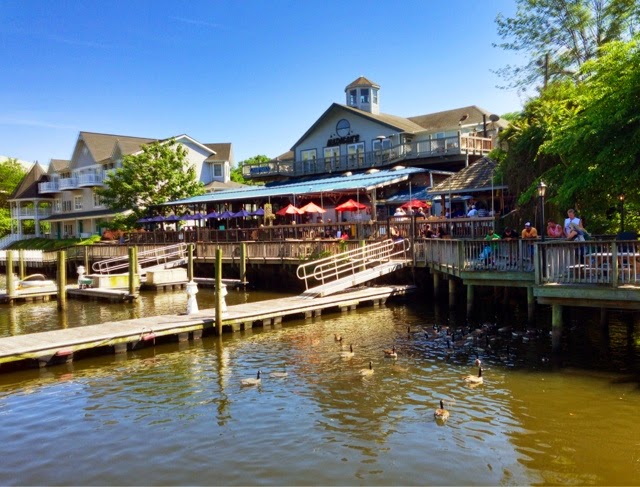
We had lunch on a terrace by the river and then explored Mill Street, the main street of the village.


Rockledge Mansion, at the end of the street, was built by the person who built Gunston Hall.


Amongst the little shops was the most extensive Christmas shop that I have ever seen..


Each tree in the shop - there must have been fifty at least - was themed.


We were drawn to the Christmas cats.


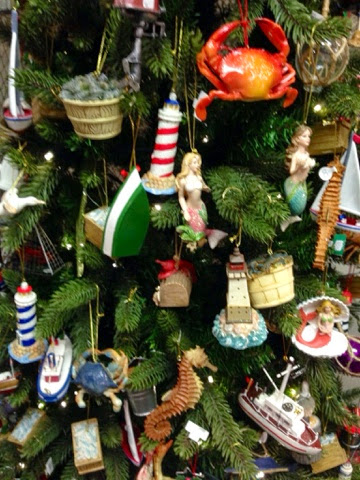
Also to the seaside tree...


The Downton Abbey tree was unexpected!


A curiosity was a tall brick house with an extraordinary barrel window...


..and a wrought iron grid over a brick enclosure which appears to depict a lamplighter - Occuquan still has its original gas lamps.


We debated for some time over lunch why this little cruise boat was labelled 'site-seeing tours' as opposed to 'sight-seeing tours' and which was the most logical..


Sunday, 1 June 2014

Gunston Hall Plantation


Gunston Hall was the home of George Mason, a contemporary of George Washington and is situated about ten miles down river of Washington's home, Mount Vernon, on the banks of the Potomac.


The approach to the house is now via an avenue of tall magnolia trees but originally the drive was planted with many cherry trees.  In its heyday the plantation covered some 5,500 acres and despite the fact that George Mason was a liberal who believed in the rights of the individual and is credited with being influential in encouraging the adoption of the US Bill of Rights, the plantation grew crops including wheat and tobacco with the assistance of an enslaved labour force of more than 90 people in addition to house servants.


These models in the museum on site showed how the estate/plantation was laid out.  The kitchen, dairy, laundry, school for the family's twelve surviving children and servants quarters were all separate to the main house.


We were given a guided tour of the house which was solid, brick-built and Georgian in style with English designed original carved wood interiors.  The house was surprisingly plain, especially in the family rooms rather than those for receiving guests.  It was also rather smaller than we expected  - some plantation houses are much bigger.  We were not allowed to take photos in the house but some of the original artefacts were on show in the museum.


Including this 'Bristol' plate..


The garden is no longer formally laid out but there is a very old gnarled box hedge running out either side of the pathfrom the back of the house..


Individual box plants looked very old indeed.


Flying low over the grounds and river were a number of very large birds of prey, 


We think that they were Bald Eagles - young ones are darker than adults and resemble Golden Eagles.